Why reviews are worth faking
A plumber with 4.8 stars and 200 reviews gets the call. A plumber with 3.9 stars and 12 reviews does not. In a market where most customers choose a provider within a few minutes of searching, a few stars decide who works this week.
That arithmetic creates a market. Anyone who has searched for a service in the UAE has seen a page of businesses with near-perfect scores and nothing to separate them. Some of those scores are earned. Some are bought.
We run a directory, which means we are exposed to the same problem and responsible for part of it. This piece sets out how they work, how to read a review page with suspicion and what we do about it.
Method 1: paid packages
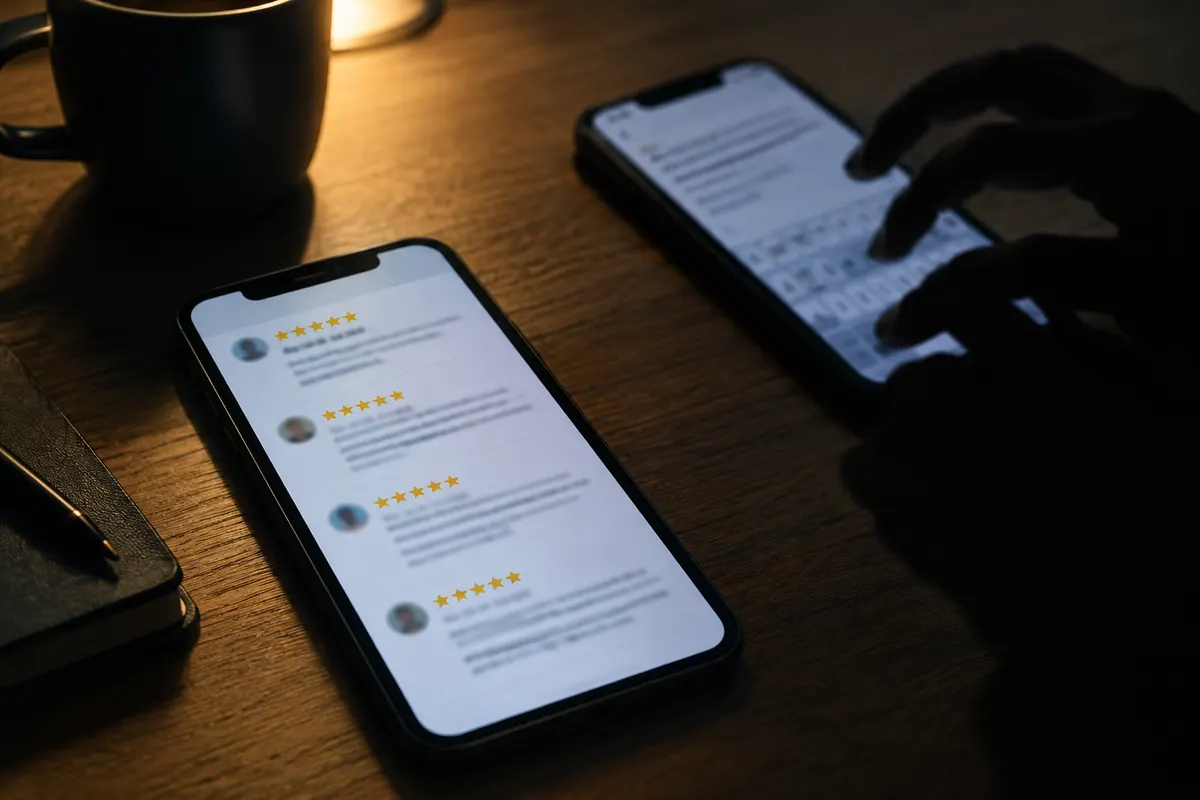
Review sellers advertise on social media and messaging groups. Packages of five-star reviews are advertised openly, priced by the number of reviews and delivered over a week or two to look natural.
The reviews come from accounts created for the purpose or from real people paid a small amount. The text is short and generic: "Excellent service, highly recommended". It rarely mentions the room, the fault, the technician's name or the price.
Platforms remove some of these reviews, but not all of them, and removal is not immediate. In the meantime the business enjoys the rating.
Method 2: review gating and incentives
Gating is subtler. The business sends a satisfaction message after the job. Happy customers receive a link to leave a public review. Unhappy ones receive a private feedback form. The public page ends up showing only the good news.
Incentives work the same way: a free service, a discount or a coupon in exchange for five stars. Google's policies prohibit both practices, and the UAE consumer rules on misleading advertising may apply to them as well.
Neither method involves a single fake person. Every review is real, and the page is still false, because it was filtered before you saw it.
Method 3: attacks on competitors
The mirror image of buying praise is buying damage. A competitor, or a service acting for one, posts a run of one-star reviews with allegations that cannot be checked: "scammer", "stole my deposit", "never came".
These reviews tend to arrive in bursts, often in the evening, from accounts with no other history. They name no date and no job.
Businesses on the receiving end lose enquiries for weeks. This is the reason we publish negative reviews but only from people who actually contacted the business through us, and the reason a business can reply publicly to anything we publish.
Method 4: staff and friends posing as customers
The cheapest method needs no seller. An owner asks staff, family and friends to post. It is common, it is hard to prove and it is usually mild: fifteen reviews from people who like the business.
It still distorts the page. A new company with 40 reviews in its first month and no repeat names has probably asked its circle.
None of these methods is unique to the UAE, and none is unique to small companies. But the UAE market is dense, multilingual and fast, which makes patterns harder to see by eye.
How to read a review page with suspicion
Spend two minutes on these checks before trusting a score.
- Sort by newest. A sudden jump of reviews in one week, followed by silence, suggests a package.
- Look for specifics. Real reviews mention the job, the area, the technician or what went wrong and how it was fixed.
- Read the three-star and two-star reviews first. They are the hardest to fake and the most informative.
- Check how the business replies. A calm, specific reply to a complaint is a better sign than a perfect score.
- Compare platforms. A business with 4.9 on one site and 3.6 on another is telling you which one to believe.
A perfect score with hundreds of reviews and no complaints is not reassuring. Every real business has an unhappy customer sooner or later.
What Moathaq does about it
We built the review system around a few rules that remove the easy routes.
A review can only be written by a person who contacted the business through Moathaq. We ask for it 48 hours after the enquiry, whatever the outcome, so the unhappy customer gets the same invitation as the happy one. We publish negative reviews.
Staff members can see each review before publication, and the report button on every review reaches a person. A confirmed fake review is removed and the business behind it is warned. A second confirmed case leads to suspension.
None of this is perfect. A determined owner can still ask friends to enquire and then review. Our answer is volume and variety: the ranking uses response rate and enquiry history too, so no single review decides a position.
If you suspect a fake review
Report it. Every review on Moathaq has a report link that opens the complaints form. Tell us what looks wrong. We aim to acknowledge within one working day, review within two and decide within seven days.
If you are a business owner facing a wave of fake one-star reviews, send us the dates, the names and anything that suggests the reviewers never used your service. We can check them against our own enquiry records. For reviews on other platforms, use the platform's own reporting tool.
If you were offered money or a discount for a review, you are entitled to refuse, and you are welcome to tell us which business asked. If a business used fake reviews in an advert or on its own site, the consumer protection section of the emirate's economic department (the Department of Economy and Tourism, DET, in Dubai) takes complaints, and an invoice or a quote helps show that you were a customer.
Frequently asked questions
Is buying online reviews illegal in the UAE?
Fake reviews can fall under the UAE rules on misleading advertising and consumer protection, and they breach the policies of Google and most platforms. We cannot give legal advice on a specific case, so ask a licensed lawyer if you are affected.
Can a business delete a bad review on Moathaq?
No. A business can reply publicly. We remove a review only when it is confirmed fake, abusive or from someone who never contacted the business through the platform.
Why does Moathaq wait 48 hours before asking for a review?
It gives the customer time to see whether the work was done, and it makes the request automatic for every enquiry, which removes the temptation to ask only happy customers.
How many reviews does a business need before I can trust the score?
We award the Trusted badge from 10 reviews by people who contacted the business, but read the content rather than counting. Ten detailed reviews with specific jobs tell you more than a hundred one-line ones.