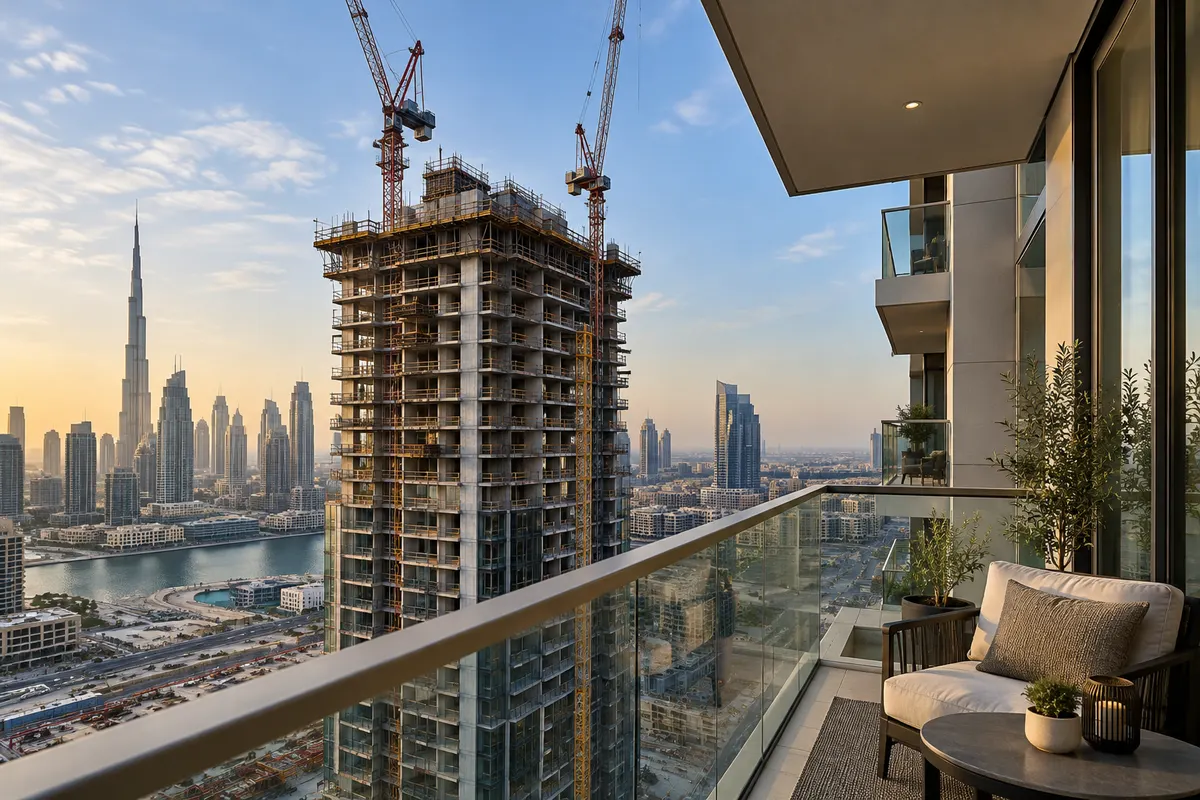
The short answer: how to buy off-plan safely in Dubai
Before paying for an off-plan property in Dubai, look the project up in the Dubai Land Department's Mashrooi service, confirm the developer and escrow account, and pay only into that account. Make sure the sale is registered in the interim register (Oqood), budget for the 4% DLD fee, and have a lawyer read the sale and purchase agreement (SPA).
Off-plan means you buy a home that is not built yet, often on a payment plan spread over the construction period. Dubai has strong rules to protect buyers: every off-plan project must have its own escrow account, every sale must be registered, and the regulator can cancel a failed project and order refunds. Those rules only help you if you use them. This guide shows you how, step by step.
What off-plan means, and what Oqood is
When you buy off-plan, you sign an SPA with a developer for a unit that exists only as plans, a show apartment and a construction site. You pay in instalments while it is built, and you get the keys at handover.
Because the unit does not exist yet, it cannot have a normal title deed. Instead, Dubai keeps an interim real estate register for units sold off-plan. Under Law No. 13 of 2008, any sale of an off-plan unit must be entered in that register, and a sale that is not registered is void. The registration is done through the DLD's developer portal, called Oqood, which is why people say "Oqood certificate" or "Oqood registration". According to the Dubai Land Department, the SPA must be registered in this provisional register within 90 days of signing.
When the building is finished, the unit moves from the interim register to the main real estate register and a title deed is issued in your name. Until then, your Oqood registration is your proof that the unit is yours.
Who checks all this? The Dubai Land Department (DLD) runs the registers, and its regulatory arm, the Real Estate Regulatory Agency (RERA), licenses developers and brokers and monitors project escrow accounts.

Check the project and the developer before you pay
The DLD's own investor guide, Know Your Rights, lists the questions to answer before you sign an off-plan SPA: is the project registered, does it have an escrow account (and what is the account number and the bank acting as escrow agent), what is the completion percentage and expected completion date, is the developer registered, and does it have the permits to sell units off-plan in this project.
You can answer most of these yourself in a few minutes:
- Open the DLD's Project Status (Mashrooi) service on the DLD website, or in the Dubai REST app under Services.
- Search by the project name or project number. Ask the sales agent for the exact registered project name if the marketing name brings up nothing.
- Open the project and read the tabs: the fact sheet (registration, start and completion dates, units), developer details, the escrow account tab and inspection details.
- Check that the developer named on the SPA and the receipts is the same company shown in Mashrooi.
- Note the completion percentage and the expected completion date, and compare them with what the brochure promises.
Then check the people. The developer is a licensed company, so you can also verify its trade licence. If a broker is selling to you, check their RERA card using our guide on how to check a real estate agent's RERA licence.
You can also compare licensed real estate developers in Dubai on Moathaq, where each listing shows the licence we checked.
The escrow account: why you pay only into it
Dubai's escrow rules come from Law No. (8) of 2007 on escrow accounts for real estate development. In plain terms, the law says:
- A developer selling off-plan must open an escrow account for each project, in the project's name, with a bank or financial institution accredited by the DLD.
- Payments from off-plan buyers, and money lent by financiers for the project, are deposited into that account.
- The money is dedicated to building that project, and the developer's creditors cannot seize it.
- After the completion certificate, the escrow agent keeps back 5% of the account's value and releases it one year after the units are registered in the buyers' names. That covers early defects.
- If a project is not completed, the escrow agent must consult the DLD and take steps to protect depositors, either by getting the project finished or by returning money to them.
- A developer needs the DLD's written authorisation before it can advertise or show a project for off-plan sale.
What this means for you is simple: pay instalments only into the escrow account shown for your project in Mashrooi. Check the account number and bank name on every payment request. A cheque made out to a sales company, a transfer to a personal account or cash "to hold the unit" sits outside the protection the law gives you.
Booking fees and the 4% DLD fee may be collected differently, so ask the developer in writing where each payment goes and get a receipt that names the project.
Fees: the Oqood registration and the DLD fee
As of November 2026, according to the Dubai Land Department, registering an off-plan (initial) sale costs:
- 2% of the sale value from the seller (the developer) and 2% from the buyer, so 4% in total
- a knowledge fee of AED 10 and an innovation fee of AED 10
- AED 1,000 when the developer registers the sale itself on the Oqood portal
In practice, many developers ask the buyer to pay the full 4%, and some advertise "DLD fee waived" offers where they cover it. Your SPA says who pays what, so read that clause before you sign. On a AED 1,200,000 apartment, 4% is AED 48,000, which is a large sum to forget in your budget.
If you later buy a finished unit on the resale market, the DLD's property sale registration fees also apply: 2% from the seller and 2% from the buyer, AED 250 for the title deed, and a registration trustee (service partner) fee of AED 4,000 plus VAT for sales of AED 500,000 or more, or AED 2,000 plus VAT below that, as of November 2026.
Other costs to ask about before you commit:
- broker commission, if you buy through a broker
- mortgage costs, if you finance part of the price
- service charges after handover, which vary by building
- any handover or administration fees the developer charges, which should be in the SPA
DLD fees can change, so confirm the current amounts on the DLD website on the day you register.
Payment plans: how to read them
Most Dubai off-plan projects are sold on a payment plan. You will see them written as ratios such as 60/40 or 70/30: the first number is what you pay during construction, the second is what you pay at or after handover. Some plans are linked to dates (every three months, for example), others to construction milestones (when the frame is finished, for example).
Questions to ask about any plan:
- Is each instalment tied to a date or to a construction milestone? Milestone plans mean you are not paying far ahead of the actual work.
- How does the completion percentage in Mashrooi compare with the percentage you have paid? If you have paid 50% and the project shows 10% built, ask why.
- What does the SPA say about late payments, penalties and interest?
- For a "post-handover" plan, who holds the risk if you cannot pay later? Read the default clause carefully.
- Can you sell or assign the unit before handover, and what fee does the developer charge for that?
A short worked example: on a AED 1,000,000 unit with a 60/40 plan, you might pay a 10% down payment (AED 100,000), then 50% in instalments during construction (AED 500,000), then AED 400,000 at handover, plus the 4% DLD fee (AED 40,000) if the SPA puts it on you. If you are taking a mortgage for the handover payment, speak to your bank early, because approval depends on your income and the bank's own rules at that time.
If the project is delayed or cancelled, or you stop paying
Delays happen, and the SPA usually sets out how much delay the developer is allowed and what compensation, if any, applies. That is why the SPA matters so much. Beyond the contract, the law gives some protection:
- If RERA cancels the project. Under Article 11 of Law No. 13 of 2008, as amended by Law No. 19 of 2017, if RERA cancels a project by a reasoned decision, the developer must refund all the money buyers paid, in line with the escrow law. The DLD's explanatory notes on Article 11 explain this, and the escrow money is protected from the developer's creditors.
- If the project stalls. Under the escrow law, the escrow agent must consult the DLD and act to protect depositors, either by getting the project completed or by refunding them.
The same Article 11 also covers the opposite case, when the buyer stops paying. The developer must notify the DLD, and the DLD gives the buyer 30 days' written notice to pay. If the buyer still does not pay, the developer's options depend on how far the build has got. According to the explanatory notes, it can keep up to 40% if the project is more than 60% complete, up to 25% if work has started but is under 60%, and up to 30% of the amounts paid if work has not started for reasons outside its control. The rest must be refunded within set time limits. A buyer who thinks the developer has misused these powers can go to court or arbitration.
These rules are detailed and the exact wording matters. If your project is late or you are struggling to pay, talk to a licensed legal consultant in Dubai before you stop paying or sign any settlement.
Use a RERA-licensed broker, and get a lawyer to read the SPA
You can buy directly from a developer's sales centre or through a broker. If you use a broker, make sure they hold a valid RERA broker card and work for a licensed brokerage. The escrow law itself makes it an offence for a developer to deal with an unregistered broker, and the Dubai REST app shows broker details. Our guide on checking a RERA licence walks you through it, and you can compare licensed real estate agencies or look at typical real estate fees.
The SPA is the document that decides what happens when things go wrong, so have a lawyer or licensed legal consultant read it before you sign. Ask them to look at:
- the unit description, size and how a difference in the final area is handled
- the anticipated completion date, the allowed delay and any compensation
- the payment schedule and the penalties for late payment
- who pays the DLD fee and any handover or admin fees
- the defects liability terms and the service charge estimate
- resale and assignment rules before handover
- what the developer can change in the design or specification
A review usually costs far less than one missed clause. Our guide on choosing a lawyer or legal consultant explains what to ask and what it should cost, and the legal services price guide gives typical fees.
If you are buying a family home, look beyond the building too: check schools, clinics and nurseries nearby. Our guide to choosing a nursery in Dubai can help if you have young children.
Your checklist before you sign, and the red flags
Before you sign the SPA or pay a deposit:
- Find the project in Mashrooi and note the project number, developer and completion status.
- Confirm the escrow account number and bank, and make sure every payment request matches them.
- Check the developer's licence and, if you use one, the broker's RERA card.
- Ask who pays the 4% DLD fee and get it in writing.
- Ask for the draft SPA and have a lawyer read it.
- Confirm that the developer will register your sale in the interim register (Oqood) within the 90-day deadline, and ask for your Oqood certificate.
- Keep every receipt, email and brochure in one folder.
Red flags that should make you stop:
- the project does not appear in Mashrooi, or shows no escrow account
- you are asked to pay into a personal account, a different company or in cash
- pressure to "pay today" before you have seen the SPA
- promises of guaranteed rental returns that are not written into the contract
- a broker who will not show a RERA card
- the seller cannot tell you the plot number or project number
When you are ready, compare licence-checked real estate developers in Dubai on Moathaq and request details from the ones that fit your plans.
Any AED amounts in this guide are typical ranges for Dubai as of October 2026; prices in other emirates are often similar or lower. They are not quotes and not offers: real prices depend on the job, the company and the date, so ask for written quotes.
Frequently asked questions
How do I check if an off-plan project is registered in Dubai?
Use the Dubai Land Department's Project Status (Mashrooi) service on its website or in the Dubai REST app. Search by project name or number to see the developer, registration details, completion percentage and escrow account. If the project does not appear, do not pay until the developer explains in writing and the DLD confirms.
What is Oqood in Dubai?
Oqood is the Dubai Land Department's portal for registering off-plan sales in the interim (provisional) real estate register. Under Law No. 13 of 2008, an off-plan sale that is not registered there is void. The DLD says the SPA must be registered within 90 days of signing, and the unit gets a title deed after completion.
How much is the DLD fee for off-plan property in Dubai?
As of November 2026, the DLD lists 4% of the sale value for registering an off-plan sale, shown as 2% from the developer and 2% from the buyer, plus AED 10 knowledge and AED 10 innovation fees. Many developers pass the full 4% to the buyer, so check your SPA to see who pays.
What is an escrow account in Dubai real estate?
Under Law No. 8 of 2007, every off-plan project in Dubai must have its own escrow account with a DLD-accredited bank. Buyers' payments go into it and can only be used to build that project, and the developer's creditors cannot seize them. Always pay into the escrow account shown for your project in Mashrooi.
What happens if an off-plan project is cancelled in Dubai?
If RERA cancels a project by a reasoned decision, Article 11 of Law No. 13 of 2008, as amended in 2017, requires the developer to refund all the money buyers paid, in line with the escrow law. If a project stalls, the escrow agent must work with the DLD to protect buyers. A lawyer can tell you how this applies to your SPA.
When do I get the title deed for an off-plan property in Dubai?
After the building is completed and handed over, the unit moves from the interim register to the main real estate register and the DLD issues a title deed in your name. Until then, your Oqood registration is your proof of purchase. Ask the developer about any handover fees before completion.
Sources
Fees, rules and steps in this guide were checked against these pages. Official sites can change without notice, so confirm the current fee before you pay.
- Dubai Land Department: Request to register the initial (off-plan) saledubailand.gov.ae
- Dubai Land Department: Project Status (Mashrooi)dubailand.gov.ae
- Law No. (8) of 2007 on Escrow Accounts for Real Estate Development in Dubaidlp.dubai.gov.ae
- Explanatory Notes on Article (11) of Law No. (19) of 2017 (interim real estate register)dlp.dubai.gov.ae
- Dubai Land Department: Know Your Rights, for real estate investors in Dubaidubailand.gov.ae
- Dubai Land Department: Property sale registration feesdubailand.gov.ae