The short answer: what bridal makeup and henna cost in the UAE
Bridal makeup in a Dubai salon typically costs AED 800 to 2,000, and a senior artist who comes to your home typically charges AED 2,000 to 2,600 or more. Bridal henna for full hands and feet typically costs AED 500 to 1,000. Book a paid trial, get every price in writing, and never accept black henna.
These are typical prices as of November 2026, based on current salon listings and price lists, and they vary with the artist, the emirate, the date and how much is included. Well-known artists with a large social media following often charge several times these figures and book out months ahead.
This guide covers what a bridal package should include, how the trial works, the main henna styles, when to book, how deposits work, and the safety checks that matter most: a licensed salon, approved products and a patch test. If you are planning the whole day, read our guide to planning a wedding in the UAE alongside this one.
Typical prices: salon, home service and well-known artists
Prices for bridal makeup in Dubai fall into three broad groups. All figures are typical ranges as of November 2026 and vary from one artist to the next.
- In a salon: typically AED 800 to 2,000 for the bridal look. Some salons include the trial in this price, others charge it separately.
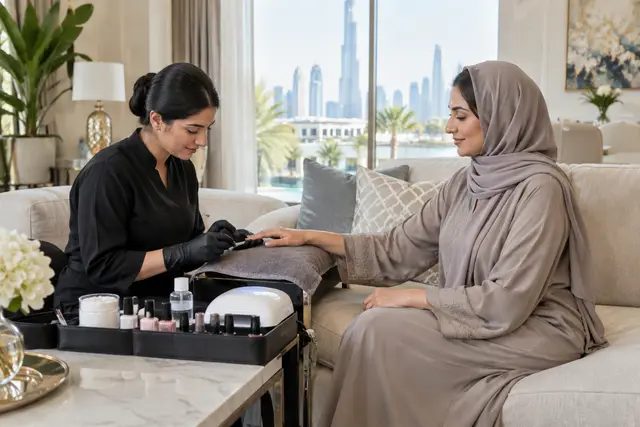
- Home or hotel service from a salon: typically AED 2,000 to 2,600 for a senior artist, sometimes more for a named lead artist. You pay for the artist's travel time and for bringing a full kit and lighting to you.
- Freelance and well-known artists: some independent artists start from about AED 500 per look, while artists with a big name and portfolio can charge several thousand dirhams, plus a travel fee and sometimes an early-morning surcharge.
Bridal henna follows a similar pattern:
- Full hands to the wrist and feet: typically AED 500 to 1,000.
- Arms to the elbow and legs to the knee, with fine bridal detail: typically AED 1,500 to 2,500.
- A home henna service for simpler designs: typically about AED 200 to 250 for full-design hands to the wrist, and a little less for the feet, as of 2026.
What moves the price: the artist's experience, the date (Thursdays, Fridays and the weeks around Eid cost more), very early start times, the number of looks, travel outside the city, and whether hair, lashes and touch-ups are included. Always ask whether the quote includes 5% VAT.
To compare quotes from several artists at once, browse licence-checked bridal makeup artists and ask each one for an itemised price.
What a bridal package should include
Two quotes of AED 1,500 can mean very different things. Before you compare, ask each artist to list exactly what is in the price.
- The trial: included, discounted or charged separately. Standalone trials in Dubai salons are commonly listed at about AED 200 to 450.
- Hair: styling, a bun or waves, and whether fitting the veil or the sheila is included. Hair is often a separate stylist and a separate fee.
- Lashes: strip lashes are usually included in bridal makeup. Individual lashes or extensions are usually extra.
- Skin preparation: some packages include a facial in the week before. Ask what it is and who does it.
- Touch-ups: will the artist stay for photos, or leave you a touch-up kit with your lipstick and powder?
- A second look: a change for the evening or for a second event costs extra.
- Family and bridesmaids: party makeup for your mother, sisters and friends is usually charged per person. Many salons offer a group rate if you book several people for the same morning.
- Henna: usually a separate artist and a separate booking, often a day or two before the wedding.
- Travel and timing: the travel fee, the arrival time and any charge for starting before a set hour.
Ask for the list on WhatsApp or by email so you have it in writing.
The trial session: how it works and what to bring
A trial is a full run-through of your bridal look, usually four to eight weeks before the wedding. It is the best way to see whether you and the artist understand each other, and whether the makeup suits your skin.
- Bring references: three to five photos of looks you like, and one or two you do not.
- Bring details of the day: a photo of your dress, the colour of the jewellery, the time of the event and whether it is indoors or outdoors.
- Arrive with a clean face and, if you can, wear a top in a similar neckline and colour to your dress.
- Check it in different light: daylight by a window, indoor light and your phone camera with flash. Bridal photos often use strong flash.
- Wear it for a few hours. See how the base holds up, whether your eyes water with the lashes, and how your skin feels.
- Ask the artist to note the products and shades so the wedding-day look matches the trial.
If anything stings, itches or turns red during or after the trial, tell the artist at once and do not use that product again. This is also why a trial matters for skin safety: it shows a reaction weeks before the day, not on the morning of your wedding.
Henna styles and when to have your bridal henna
Henna artists in the UAE work in several styles, and many can blend them. Knowing the names helps you brief the artist and compare prices.
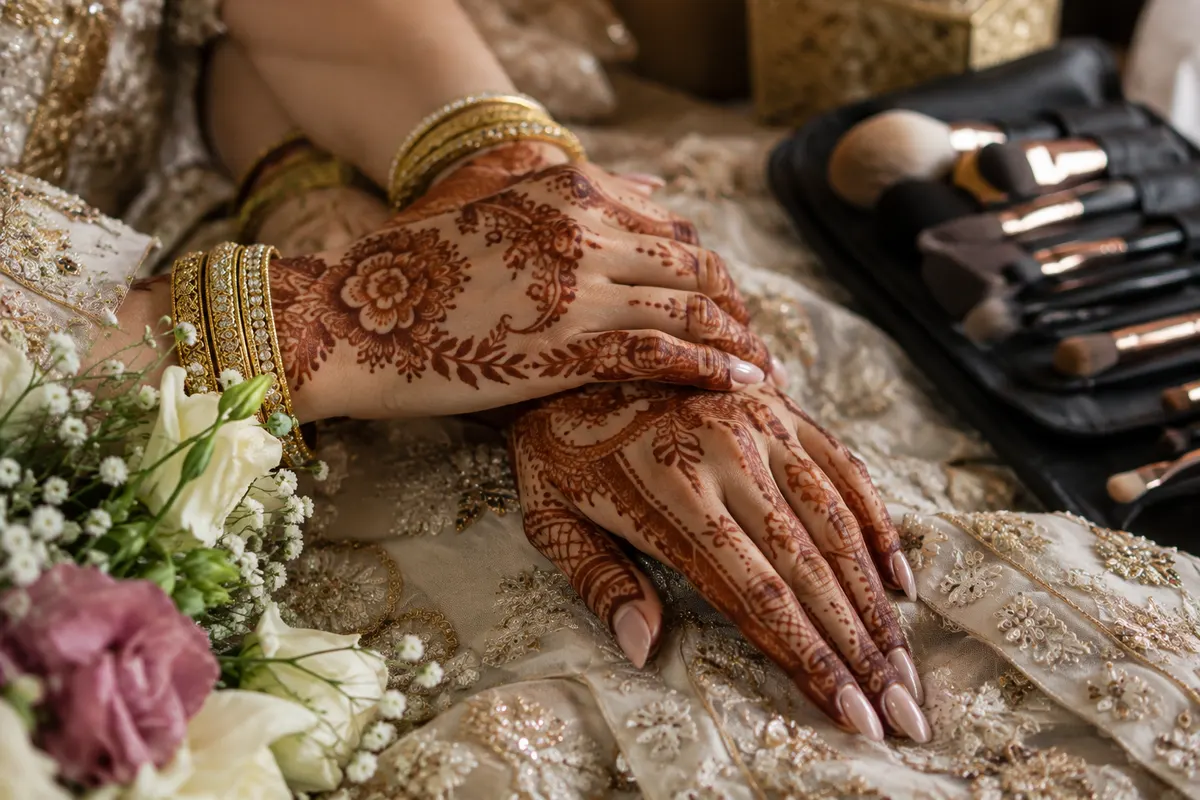
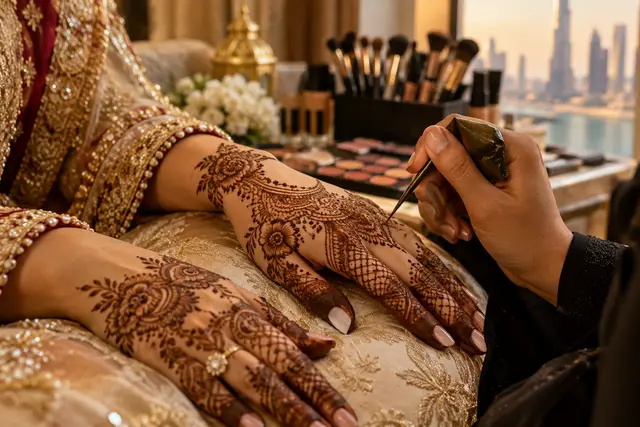
- Traditional Emirati and Khaleeji henna: bold floral and leaf patterns, often with filled fingertips, and the full-palm designs many Emirati brides choose. Usually quicker to apply than Indian bridal henna.
- Arabic henna: flowing trails of flowers and leaves with more open space, popular for guests and lighter bridal looks.
- Indian and Pakistani bridal mehndi: dense, fine detail covering the hands and arms, often with portraits or the couple's initials hidden in the design. It can take several hours.
- Moroccan and geometric styles: lines, grids and symmetrical shapes.
- "White henna": not henna at all. It is usually a body paint or adhesive with glitter. Ask what it is made of, as some products are not meant for long contact with skin.
- "Black henna": avoid it completely. More on this in the safety section below.
Timing: natural henna starts orange and darkens over the next day or two, so most artists suggest applying bridal henna one to two days before the wedding. Leave the paste on as long as the artist advises, avoid water for the first hours, and book the henna before any hair removal or scrubbing, not after.
The colour of natural henna is brown, orange-brown or reddish-brown, according to the US Food and Drug Administration. A jet-black stain within an hour is a warning sign, not a feature.
Black henna, PPD and skin safety
"Black henna" is usually henna mixed with a hair dye chemical called PPD (para-phenylenediamine), which darkens the stain and speeds it up. The US Food and Drug Administration says PPD can cause dangerous skin reactions in some people and that there is no way to tell in advance who will react. The Florida Department of Health reports allergic reactions and injuries that include permanent scarring.
In the UAE, the Dubai Health Authority warned in 2019 that black henna is a major health hazard, especially on children, and urged people to use approved products only. Reported effects include blistering, open sores and scarring. Dubai Municipality said in 2018 that salons found using black henna or other unapproved products would have them withdrawn and face a AED 2,000 fine, with temporary closure for repeat offences. Penalties can change, so confirm the current rules with Dubai Municipality.
How to protect yourself:
- Ask the artist what is in the paste. Natural henna paste is usually just henna powder, lemon or water, sugar and essential oils.
- Ask for a patch test on a small area of skin a few days before the bridal application, especially if you have sensitive skin or have reacted to hair dye before.
- Be careful with cheap home henna offered through social media with no salon behind it. The 2019 warning said this is where black henna is most often found.
- If you get itching, redness, swelling or blisters after henna, wash it off, do not apply more, and see a doctor. A licensed dermatology clinic can assess the reaction.
When to book, deposits and the contract
Good artists fill their diaries early, especially for the cooler months from October to April, Thursday and Friday nights, and the weeks before and after Eid, when many families hold weddings and celebrations.
- Six to nine months before for a well-known artist or a peak-season date.
- Three to four months before for most salons and established freelancers.
- Four to eight weeks before: the makeup trial.
- One to two weeks before: confirm the timings, the address, the number of family members and the final balance.
- One to two days before: bridal henna.
Deposits: most artists ask for a deposit to hold the date, often a fixed sum or a share of the total. Before you pay, ask what happens if you change the date, if you cancel, or if the artist cannot come. Get the answer in writing. The same rules apply as for any service: our guide on how to check a business before paying a deposit walks you through it.
What the written agreement should say:
- The artist's name and the business name on the trade licence.
- The date, start time and address.
- Exactly what is included: looks, hair, lashes, touch-ups, family members.
- The total price, whether VAT is included, the deposit paid and when the balance is due.
- The cancellation and date-change terms on both sides.
- Who replaces the artist if she is ill, and whether you can refuse the replacement.
Pay the deposit by card or bank transfer to the business, not cash to a personal account, and keep the receipt.
Checking the salon or artist before you book
A wedding morning is not the time to discover that your artist has no licence or uses products of unknown origin. A few checks take ten minutes.
- Trade licence: ask for the salon's licence number and check that the business name and activity match. Our guide on how to verify a UAE trade licence shows how.
- Home service permit: in Dubai, salon staff need a separate permit to provide services in clients' homes, according to a Dubai Municipality official quoted in 2018. If an artist is coming to your home, ask whether her salon holds that permit.
- Products: ask which brands she uses and whether they are sealed and within date. A professional kit is clean and organised, and brushes are washed between clients.
- Portfolio: look for photos of real clients in different skin tones and lighting, not only edited images. Ask for one or two brides you can contact.
- Reviews: read them with care. Our guide on how online reviews get faked explains the signs.
Red flags: no licence or salon name, cash only, no written confirmation, black or "instant" henna, pressure to pay the full amount early, and a portfolio made up of photos copied from other artists.
Moathaq lists licence-checked beauty salons and home salon services as well as bridal artists, so you can compare businesses whose trade licence we have checked. You can also start with bridal makeup artists in Dubai. If you want to get in shape before the day, our guide to Pilates and ladies-only gyms in Dubai may help.
When you are ready, compare licence-checked bridal makeup artists and request quotes from a few of them.
Any AED amounts in this guide are typical ranges for Dubai as of October 2026; prices in other emirates are often similar or lower. They are not quotes and not offers: real prices depend on the job, the company and the date, so ask for written quotes.
Frequently asked questions
How much does bridal makeup cost in Dubai?
Typically AED 800 to 2,000 in a salon and AED 2,000 to 2,600 or more for a senior artist at your home, as of November 2026. Well-known artists can charge several thousand dirhams. Ask whether hair, lashes, the trial and VAT are included.
How much is bridal henna in Dubai?
Bridal henna for full hands and feet typically costs AED 500 to 1,000 as of November 2026. Detailed designs up to the elbows and knees typically cost AED 1,500 to 2,500. Prices depend on the artist, the coverage and whether she comes to your home.
Do I need a makeup trial before my wedding?
It is strongly recommended. A trial four to eight weeks before shows whether the look suits you, how it photographs and whether any product irritates your skin. Standalone trials in Dubai salons are commonly listed at about AED 200 to 450.
When should I apply bridal henna before the wedding?
Most artists suggest one to two days before the wedding. Natural henna starts orange and darkens over the following day or two. Do hair removal and scrubs before the henna, not after.
Is black henna safe?
No. Black henna usually contains PPD, a hair dye chemical that can cause blisters, open sores and scarring in some people. The Dubai Health Authority has warned against it, and Dubai Municipality has fined salons that use it.
How far in advance should I book a bridal makeup artist?
Three to four months is usually enough for most salons. For a well-known artist, or a date in the October to April season or around Eid, book six to nine months ahead. Get the deposit and cancellation terms in writing.
Sources
Fees, rules and steps in this guide were checked against these pages. Official sites can change without notice, so confirm the current fee before you pay.
- US Food and Drug Administration: Temporary tattoos, henna/mehndi and "black henna" fact sheetfda.gov
- Florida Department of Health: Black hennafloridahealth.gov
- The National: Dubai Health Authority issues warning over dangerous black henna (2019)thenationalnews.com
- Gulf News: Dh2,000 fine for black henna in Dubai (2018)gulfnews.com
- Gulf News: Dubai salon staff face penalties for home services without a permit (2018)gulfnews.com