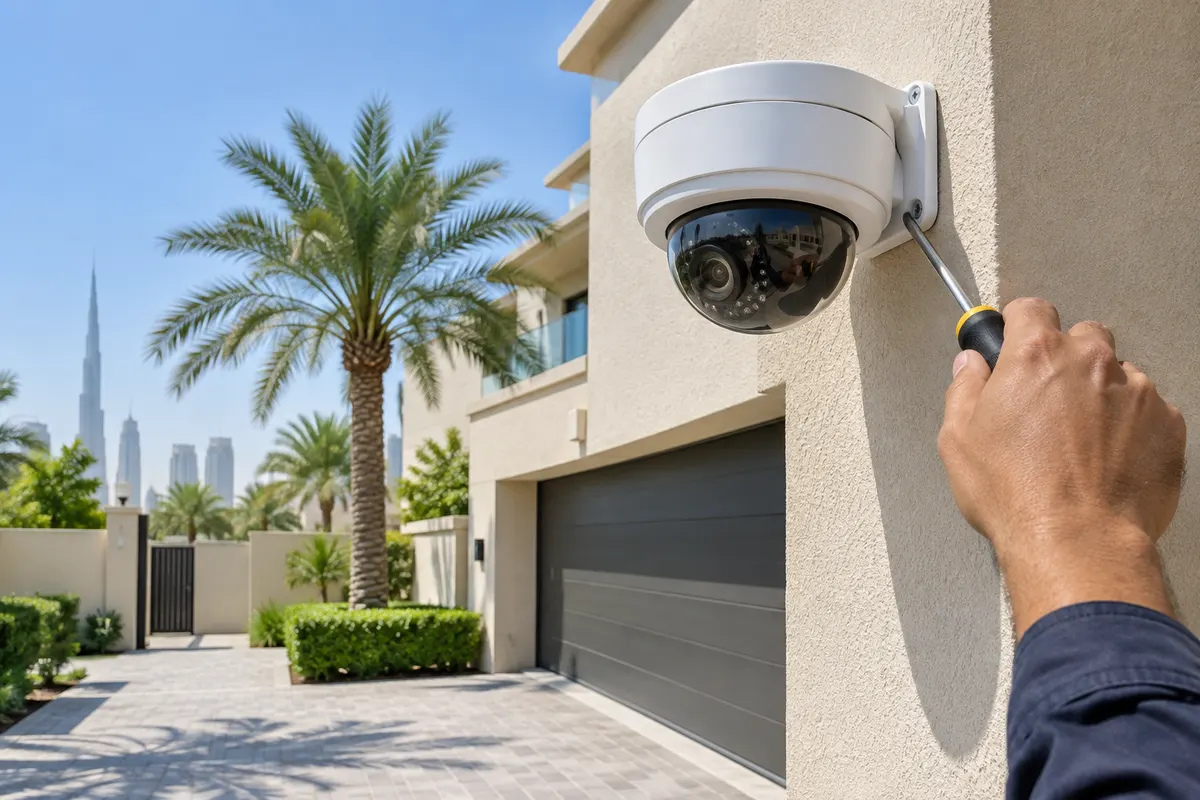
The short answer
In Dubai, CCTV in commercial premises is regulated by the Security Industry Regulatory Agency (SIRA). Its technical manual, the Preventive Systems Manual issued as Administrative Resolution No. 13 of 2025, sets the standard for covered establishments: Full HD cameras, recordings kept for at least 31 days, approved warning signs, a SIRA-registered maintenance company and installation by licensed staff.
A private villa is a different case. We did not find an official rule that requires a family home to have CCTV, and owners commonly fit cameras themselves or through a contractor. What does apply to everyone is UAE privacy law: a camera must protect your own property and must not look into a neighbour's home, a bathroom or any other private space.
Typical installed prices as of November 2026 run from about AED 3,000 to 8,000 for a villa with four to eight wired cameras, and from about AED 4,000 to 12,000 for a small shop built to SIRA's standard. Prices vary with the number of cameras, cabling and storage. This guide explains each rule, the camera choices and what to check before you pay. When you are ready, you can compare licence-checked IT and security system companies on Moathaq.
Who regulates CCTV in Dubai
The security industry in Dubai is governed by Law No. 12 of 2016 Regulating the Security Industry in the Emirate of Dubai. SIRA applies it. Under that law and its implementing bylaw, Resolution No. 1 of 2018, installing security systems is a licensed activity, and individuals who work on them need their own licence, for example as a security system technician or engineer.
The bylaw also protects the footage itself. Copying, displaying or sending pictures from a security system to anyone not legally authorised to see them needs a special licence, and licensed providers must give SIRA access to their systems and records.
The detailed technical rules sit in the Preventive Systems Manual (Administrative Resolution No. 13 of 2025). It applies to the establishments specified in Resolution No. 1 of 2018, and it has chapters for particular facility types such as hotels, shopping malls, schools, healthcare facilities and holiday homes. You can read the manual and both laws on the Dubai Legal Portal, dlp.dubai.gov.ae.
Other emirates, briefly. In Abu Dhabi, the Monitoring and Control Centre (MCC) oversees CCTV in residential buildings, residential communities and commercial buildings, under a national guide for CCTV systems. In November 2026 it started a year-long compliance campaign and asked owners and developers to use only companies licensed and accredited by the MCC, which can be checked on mcc.gov.ae. For Sharjah and the northern emirates, ask the local police or the licensing authority which rules apply to your premises.
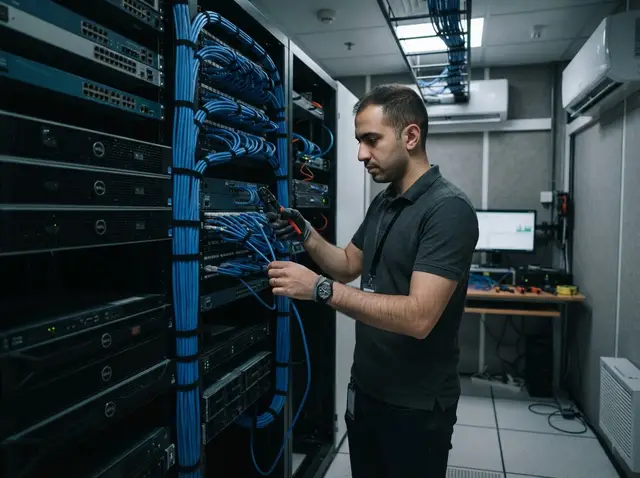
What SIRA's manual asks of commercial premises
If your business falls under SIRA's rules, these are the main points of the Preventive Systems Manual as of November 2026:
- Image quality. Cameras and recordings of at least 1080p Full HD. Live view at 25 frames per second or more for each camera.
- Recording period. Recordings must be kept for at least 31 days. Where recording is triggered by motion, it must still cover at least 31 days, at 10 frames per second or more.
- Visible cameras. Cameras must be clearly visible. Hidden cameras, pan and zoom cameras in private areas, and rooftop cameras that see beyond the boundary of the premises are prohibited unless SIRA approves them.
- Outdoor cameras. Cameras or housings used outdoors must be rated at least IP66 against dust and water.
- Signs. SIRA-approved warning signs at all main entrances and inside lifts.
- Access and copying. The recorder kept in a secure place, access limited to authorised staff with a log, and every copy of footage recorded on the approved form, saying who made it and who received it.
- Approvals for connections. Wireless links, and links to outside networks or other systems, need SIRA approval in writing.
- Maintenance. An annual maintenance contract with a SIRA-registered company, with at least four preventive visits a year. Changes to the design or coverage must be recorded and SIRA notified.
Some facility types have their own chapters with longer lists of camera positions, for example hotels. Whether a particular shop must meet the manual depends on its activity. SIRA's website has a commercial activities search, and your licensed installer or the authority that issues your trade licence can tell you whether SIRA approval is part of your licensing. If you are still setting up, our guide on how to verify a Dubai trade licence explains the licence side.
Privacy: where a camera must never point
CCTV is legal in Dubai when it protects your own property. It becomes a crime when it is used to intrude on someone else's private or family life.
Federal Decree-Law No. 34 of 2021 on Combating Rumours and Cybercrimes makes it an offence to use an information network or technology device to invade a person's privacy without consent, including by taking or recording their pictures. A networked camera system is exactly such a device. Reported penalties include imprisonment and fines that can reach AED 500,000. The UAE Penal Code also protects private life. The official texts are on uaelegislation.gov.ae, and for a specific dispute you should take advice from a licensed lawyer.
In practice, for a villa or a shop:
- Do not point cameras at a neighbour's windows, garden, balcony or front door. Angle them at your own gate, door, driveway and walls, and mask any part of the image that shows the neighbour's property. Most recorders let you black out zones.
- Never put cameras in bathrooms, toilets, changing rooms or bedrooms, including a domestic worker's room. In a shop, keep cameras away from fitting rooms and staff washrooms.
- Avoid recording sound unless you have a clear reason and have checked it is lawful. Recording private conversations is treated more strictly than recording images.
- Do not post footage online to shame a thief, a delivery driver or a neighbour. Sharing a clip that identifies someone can itself be an offence. Give footage to the police if a crime has happened.
- Cover only what you need. A camera covering a shared corridor, a street or a common garden in a community can lead to complaints. Check your community or building rules before you mount one.
For businesses, footage of identifiable people is also personal data. Federal Decree-Law No. 45 of 2021 on the Protection of Personal Data applies on the mainland, while the DIFC and ADGM free zones have their own data protection laws. Keep footage only as long as needed, limit who can see it, and tell people the area is recorded.
Home or shop: how the requirements differ
A private villa or apartment
- We did not find an official rule requiring a family home in Dubai to have CCTV or SIRA approval for basic cameras on its own property. Check with SIRA if you are unsure, and check your community, developer or building rules, which can limit where cameras go.
- In an apartment, the corridor, lobby and car park are usually common areas run by the building. A camera or video doorbell on your front door that records the corridor may need the building manager's permission.
- If you rent, ask the landlord in writing before drilling or running cables, and agree what happens to the system when you leave.
- If you let the villa as a holiday home, check SIRA's rules. The Preventive Systems Manual has a chapter on holiday homes.
- A wired system still involves power points and cable routes. Electrical work in Dubai has its own rules, explained in our guide to electrical work in Dubai.
A shop, office or other commercial premises
- Your activity may require a SIRA-approved system as part of licensing. If it does, the system must meet the Preventive Systems Manual, be installed by a licensed company, and be maintained under an annual contract.
- Keep recordings for at least 31 days, put up the approved signs, and control who can view and copy footage.
- Keep the approval documents, the maintenance contract and the visit reports where you can show them at an inspection.
- If you sit inside a mall or a managed building, the landlord may have its own security rules and a preferred contractor list. Ask before you sign with an installer.
Choosing cameras: IP or analogue, resolution, night vision and storage
IP or analogue. IP cameras send a digital signal over a network cable, often powered through the same cable (PoE), to a network video recorder (NVR). They give sharper images, are easier to extend and support features such as smart motion alerts. Analogue HD cameras use coaxial cable and a digital video recorder (DVR). They can be cheaper and are useful when old cabling is already in place, but check that the image meets 1080p if SIRA's rules apply to you. For a new villa or shop, most installers now recommend IP.
Wi-Fi cameras. Battery or plug-in Wi-Fi cameras are quick to fit in an apartment, but they depend on your Wi-Fi and often on a cloud subscription. For commercial premises, wireless links need SIRA approval under the manual.
Resolution. 1080p (2 MP) is the minimum under SIRA's manual. 4 MP or higher helps with faces and number plates at a distance, but uses more storage. A well-placed 1080p camera is often more useful than a badly placed 4K one.
Night vision. Infrared cameras record in black and white in the dark, usually to 20 or 30 metres. Some cameras keep colour at night with a small white light or a very sensitive sensor. Ask for a night sample from a similar site.
Outdoor cameras. Dubai heat, dust and humidity are hard on equipment. Choose cameras rated for high temperatures and at least IP66, as the manual requires outdoors, and mount them out of direct afternoon sun where possible.
Storage. Storage depends on the number of cameras, resolution, compression (H.265 uses less space than H.264) and whether you record all the time or only on motion. As a rough guide, an eight-camera shop recording continuously at 1080p for 31 days usually needs several terabytes. Ask the installer to calculate the disk size in writing for your retention period, and to show you that the oldest recording on the system is at least 31 days old once it has been running a month.
Cyber security. Change the default password, update the recorder's firmware, turn off remote access you do not use, and keep the recorder on a separate network from guests' Wi-Fi.
Typical CCTV installation costs in Dubai
There is no official tariff. These are typical installed prices in Dubai as of November 2026, collected from what installers advertise. They vary with the brand, cable runs, wall finishes and storage, so treat them as a guide and get at least two written quotes.
- Apartment, two to four Wi-Fi or plug-in cameras: about AED 800 to 2,500 including fitting and set-up.
- Villa, four to eight wired IP cameras with an NVR: about AED 3,000 to 8,000.
- Large villa, eight to sixteen cameras: about AED 7,000 to 15,000 or more, especially with cabling through finished walls.
- Small shop or office built to SIRA's standard, four to eight cameras with 31-day storage: about AED 4,000 to 12,000, before any approval fees.
- Labour per camera, where quoted separately: often AED 80 to 200, more for high walls or long cable runs.
- Extra hard drive capacity: a few hundred dirhams per drive, depending on size.
What moves the price
- the number of cameras and how far each is from the recorder
- concealed cabling in a finished villa against surface trunking
- camera resolution, night vision type and outdoor rating
- recorder size and disk capacity for your retention period
- monitors, remote viewing set-up and integration with alarms or access control
- SIRA approval steps, signs and documents for commercial premises
Ask the installer whether any SIRA fees are included in the quote or billed separately, and check the current fee on SIRA's own portal rather than relying on a figure in a quote. Ask too whether VAT is included.
Maintenance contracts
For premises under SIRA's manual, an annual maintenance contract with a SIRA-registered company is required, with at least four preventive visits a year. The contract should also set out how quickly the company responds to a fault and what happens if it fails to perform, and the facility must tell SIRA if the contract is not carried out.
For a villa, a contract is optional but often worth it, because cameras fail quietly. A dead hard drive or a camera knocked out of line can go unnoticed until the day you need the footage.
Typical yearly prices as of November 2026 are about AED 500 to 1,500 for a villa system and about AED 1,000 to 4,000 for a small shop, depending on the number of cameras and visits. A good contract states:
- the number of preventive visits and what each covers: cleaning lenses, checking angles, testing night vision, checking the disk and the oldest recording, updating firmware
- the response time for a fault, and whether it is the same at weekends
- whether parts are included or charged separately
- a written report after each visit, which a SIRA-covered business should keep
- the name of the licensed technician who attends
What to check before you hire an installer
- Check the trade licence. The company's licence should cover security systems or CCTV installation, not only general trading or IT. See how to verify a Dubai trade licence.
- For a shop or office, check SIRA licensing. Ask for the company's SIRA licence and look it up with SIRA's company search on sira.gov.ae. Ask whether the technicians who will work on site hold SIRA licences, since the manual requires the maintenance crew to be licensed. In Abu Dhabi, check MCC accreditation on mcc.gov.ae.
- Ask for a site survey and a camera plan. A good installer walks the property, marks each camera on a plan, shows what each one will see, and points out any view of a neighbour or a private area.
- Get an itemised written quote. Cameras, recorder, disk size and retention period, cabling, labour, SIRA steps if any, VAT and warranty, each on its own line.
- Ask about warranty and handover. Who holds the admin password at the end? You should. Ask for the passwords, a short demonstration and a copy of the configuration.
- Pay in stages. A deposit, then the balance after the system works and you have checked recordings, night images and remote viewing. Our guide on how to check a contractor before paying covers deposits and payment terms.
Warning signs: an installer who offers to hide cameras without mentioning approval, offers to point a camera "a little" into the neighbour's plot, cannot name the SIRA requirements for your shop, or will not put the quote in writing.
On Moathaq, a verified badge means we have checked the business's licence against official sources. It does not rate the quality of the work. Read what a verified badge on Moathaq means, then start with IT and security system companies in Dubai. For power points and cabling, you can also compare licensed electricians in Dubai.
Any AED amounts in this guide are typical ranges for Dubai as of October 2026; prices in other emirates are often similar or lower. They are not quotes and not offers: real prices depend on the job, the company and the date, so ask for written quotes.
Frequently asked questions
Do I need SIRA approval for CCTV at my villa in Dubai?
We did not find an official rule that requires SIRA approval for basic cameras covering a private family home. Hidden cameras, cameras that see beyond your boundary and holiday homes are treated differently, and community rules may apply. If you are unsure, ask SIRA before you install.
How long must a shop in Dubai keep CCTV footage?
For premises covered by SIRA's Preventive Systems Manual, at least 31 days, including where recording is triggered by motion. Some facility types have extra rules in their own chapters, so ask your licensed installer what applies to your activity.
Can my CCTV camera show my neighbour's house?
It should not look into a neighbour's windows, garden, balcony or door. Using a camera to intrude on someone's private life without consent can be an offence under the UAE cybercrime law. Angle cameras at your own property and mask any part of the picture that shows the neighbour's.
How much does CCTV installation cost in Dubai?
As of November 2026, typical installed prices are about AED 800 to 2,500 for an apartment with a few Wi-Fi cameras, AED 3,000 to 8,000 for a villa with four to eight wired IP cameras, and AED 4,000 to 12,000 for a small shop built to SIRA's standard. Prices vary, so get itemised written quotes.
Are IP cameras better than analogue cameras?
For most new installations, yes: IP cameras give sharper images, are easier to extend and can be powered through the network cable. Analogue HD can save money where coaxial cabling already exists. For a shop under SIRA's rules, either type must record at 1080p or better.
Do shops in Dubai need a CCTV maintenance contract?
Premises covered by SIRA's manual need an annual maintenance contract with a SIRA-registered company, with at least four preventive visits a year. For a villa a contract is optional, but regular checks catch failed disks and moved cameras before you need the footage.
Can I post CCTV footage of a thief on social media?
It is safer not to. Sharing footage that identifies a person can itself break UAE privacy law, even if they did something wrong. Report the crime to the police and give them the footage instead.
Sources
Fees, rules and steps in this guide were checked against these pages. Official sites can change without notice, so confirm the current fee before you pay.
- Dubai Legal Portal: Administrative Resolution No. 13 of 2025, the Preventive Systems Manual (SIRA)dlp.dubai.gov.ae
- Dubai Legal Portal: Law No. 12 of 2016 Regulating the Security Industry in the Emirate of Dubaidlp.dubai.gov.ae
- Dubai Legal Portal: Resolution No. 1 of 2018, Implementing Bylaw of Law No. 12 of 2016dlp.dubai.gov.ae
- Security Industry Regulatory Agency (SIRA): official website and licensed companies searchsira.gov.ae
- UAE Legislation: Federal Decree-Law No. 34 of 2021 on Combating Rumours and Cybercrimesuaelegislation.gov.ae
- Abu Dhabi Media Office: Monitoring and Control Centre launches Reassuring Vision campaign on CCTV compliance (November 2026)mediaoffice.abudhabi